Work with me

Sports science consulting
& coach workshops.

Practical workshops on AI, data, and leadership, plus sports-science support for coaches and athletic programs.

Based in Riviera Beach, Florida. Serving Palm Beach County.

Discuss a collaboration
Explore the three workshops

Start with your staff’s question.

For coaches, schools, clubs, and training facilities in Palm Beach County. We can work together on one focused project, shaped around your people, resources, and priorities.

Available now · Coach education

Three workshops. One useful next step.

Each workshop includes practical examples, guided practice, and a one-page resource to use afterward. Choose the topic that fits your staff.

Download all three outlines (PDF)
Workshop 01

AI for Coaches: A Practical Starting Point

For: Coaches with little or no AI experience. No coding knowledge required.

Understand what AI is, where it can help, and where it needs checking. See examples from my own work, then practice giving useful instructions and improving the result for an everyday coaching task.

You leave with: A one-page workflow card with reusable instructions, review checks, and a plan for your next use.

What we’ll cover in AI for Coaches: A Practical Starting Point
  1. What AI is and what it isn't

    Understand the basics, useful applications, possible errors, and the coach's responsibility for checking outputs.

  2. Examples from my work

    See an everyday use and a tool or resource I have built. Examine the problem, AI's contribution, and the work I had to check or change.

  3. Live demonstration

    Turn fictional notes into an athlete briefing. Improve a vague request with context, constraints, and a clear format.

  4. Guided practice

    Complete one small task using a provided example or your own non-sensitive material.

  5. Review and improve

    Check for invented details, missing context, impractical suggestions, and language that needs changing. Revise the output.

  6. Plan the first use

    Save your instructions, choose when to try the workflow again, and decide how to judge its usefulness.

The exercise: Turn fictional coaching notes into a short athlete briefing. Preserve the planned session, check for invented details, and identify anything that needs clarification. Use fictional or non-sensitive material throughout.
Ask about the AI workshop
Workshop 02

From Data to Coaching Decisions

For: Coaches and performance staff who collect data, receive reports, or want to start a simple measurement process.

Start with the coaching question, then choose useful measures from the tools you already have. Practice collecting consistently, interpreting changes with context, and sharing a clear finding and next step with athletes and staff.

You leave with: A one-page plan connecting your question, measures, collection process, interpretation, audience, and next action.

What we’ll cover in From Data to Coaching Decisions
  1. Start with the decision

    Turn a broad concern into a question about a specific quality, group, time frame, and decision.

  2. Choose useful measures

    Consider relevance, measurement quality, feasibility, and whether a result could change the decision.

  3. Define collection

    Agree on the tool, protocol, units, timing, responsible person, and handling of missing or inconsistent entries.

  4. Interpret a case

    Separate observations from explanations. Consider measurement error, individual patterns, recent training, and missing context.

  5. Communicate and share

    Create a short staff update and an athlete-facing explanation. Decide who needs the information and who follows up.

  6. Apply the process

    Complete a plan for one question from your own setting, including a next step and review date.

The exercise: Work through a fictional acceleration-testing case with a missing result and a changed starting procedure. Decide which comparisons hold up, what remains uncertain, and how to communicate the next step and who owns it.

Ask about the data workshop
Workshop 03

Building a Culture of Ownership

For: Coaches, assistants, and staff leaders who want to develop leadership within their actual responsibilities.

Help athletes and staff take initiative through clear expectations, supported responsibility, and useful feedback. Turn a value into observable behavior, practice a conversation, and design one leadership routine to try with your group.

You leave with: A one-page ownership plan with a clear behavior, responsibilities, decision boundaries, support, and a review date.

What we’ll cover in Building a Culture of Ownership
  1. Make culture observable

    Discuss a fictional situation with an unclear standard or missed responsibility. Identify the behaviors involved.

  2. Define the standard

    Choose one value and describe what it looks like for athletes, assistants, and the lead coach.

  3. Create supported responsibility

    Design a small leadership opportunity with clear expectations, decision boundaries, resources, and support.

  4. Practice a conversation

    Rehearse addressing a missed commitment or responding to a concern. Agree on a next step and follow-up.

  5. Build one routine

    Design an athlete-led preparation check, staff decision review, or another routine suited to your setting.

  6. Plan a small trial

    Choose when to try the routine, which behavior to observe, and when to review it. Culture develops through follow-through.

The exercise: An assistant is asked to lead a warm-up without clear guidance, then the head coach takes over. Clarify the responsibility, rehearse a private conversation, and redesign the next opportunity with agreed boundaries and feedback.

Ask about the leadership workshop

We’ll agree on the audience, location, format, and pricing together. Examples can be adapted to the people you coach and the resources you already have.

Sports science
support

Review how you test, monitor, and report. Identify what each measure can tell you, what needs more context, and who follows up.

Start with a process you already use, such as a testing session, wellness questionnaire, or daily staff report.

You leave with: a written review, clear priorities, and recommendations your coaches can use.

Review our monitoring process

Training-space &
staff-workflow planning

A developing service focused on how athletes, staff and equipment move through a training space. We start with your current setup, identify where the work gets interrupted, and explore practical changes with your team.

You leave with: a priorities brief, a conceptual equipment layout, and an athlete/staff flow map for discussion.

Architectural design and construction documentation remain with the appropriate design professionals.

Discuss your space and staff workflow Explore a high-school facility concept
Concept study · High-school performance

Plan the space around the work.

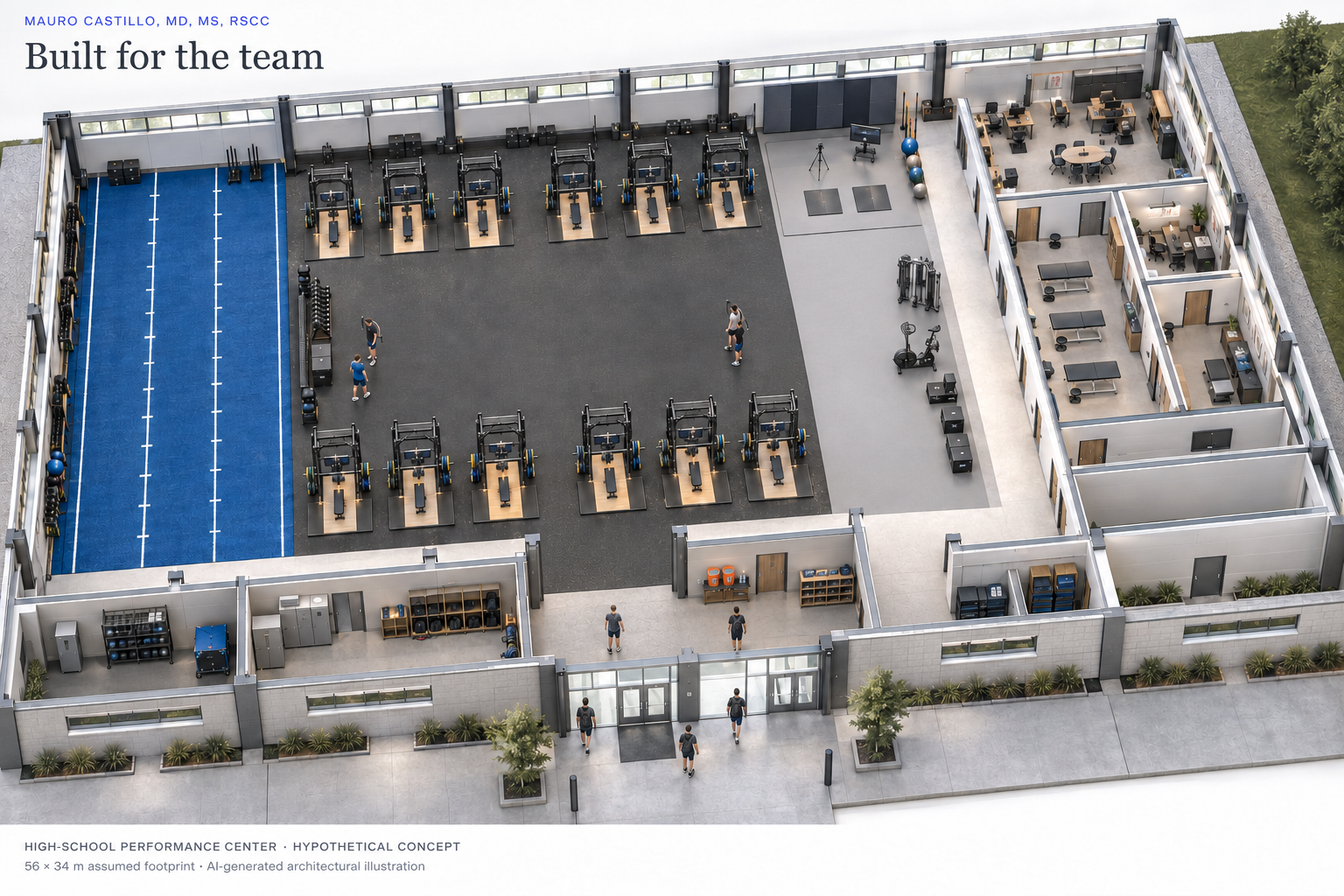
A hypothetical high-school facility exploring equipment placement, athlete routes, and staff handoffs. Use it to start a conversation about where work gets interrupted in your own space.

Hypothetical high-school performance facility with a turf zone, twelve rack stations, adjacent rehabilitation exercise and open testing, plus a shared coaches’ and athletic trainers’ office connected to private clinical spaces.

Hypothetical concept. AI-generated architectural illustration based on assumed dimensions; not a completed client project or construction document.

Open full-size illustration (new tab)
See layout decisions and athlete flow

Keep testing in view.

An open testing bay sits beside training and rehabilitation exercise, with circulation routed around the assessment space.

Give staff a shared base.

Coaches and athletic trainers share an office with direct access to treatment tables and private consultation.

Make athlete routes clear.

Arrival branches toward training or care without sending athletes through working rack stations or the staff office.

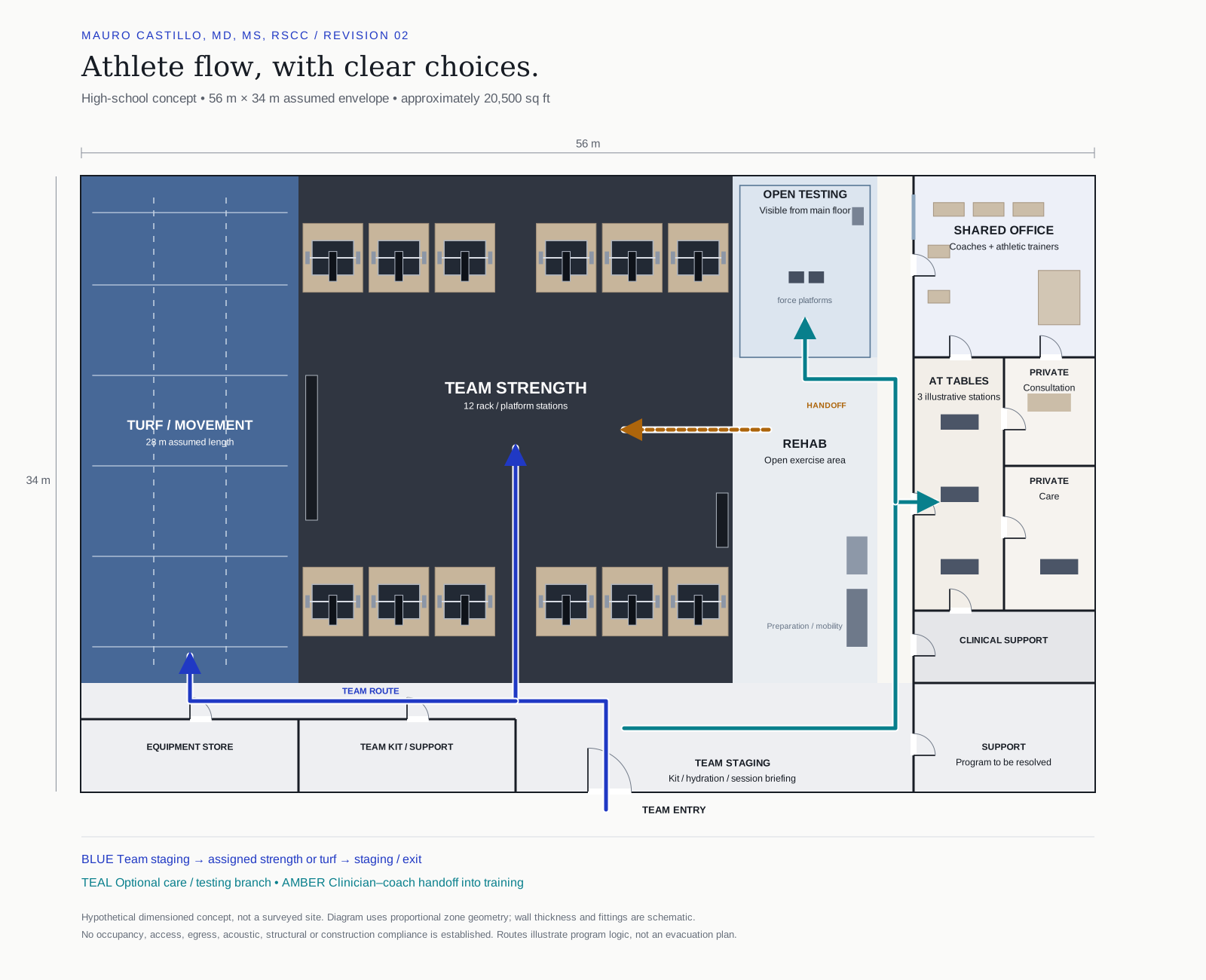
How athletes move through the space

The front arrival area gives athletes a clear starting point. From there, routes branch by purpose; testing is an optional destination, not a checkpoint for every athlete.

Proportional concept plan with labeled routes for a routine team session, optional care or testing, and a clinician-coach handoff. The three routes are explained below.
Open full-size flow plan (SVG, new tab)
  1. Team session Blue route

    School or locker-room connection → arrival and staging → assigned strength or turf area → staging and exit. The group splits before reaching the working stations.

  2. Care or testing Teal route

    Arrival and staging → side circulation route → athletic training or the open testing bay. Athletes bypass working rack platforms and the shared staff office.

  3. Clinician–coach handoff Amber route

    Rehabilitation exercise → shared observation → an agreed training task. The appropriate clinician and coach agree the next step; the route does not imply automatic clearance.

Planning assumptions: a 56 × 34 m footprint, approximately 20,500 sq ft, with twelve rack stations. The plan uses proportional zones; the illustration may differ in fine geometry. This example assumes a connection to existing school circulation and locker rooms. Dimensions, equipment clearances, accessibility and building requirements need site-specific review.

Research on collaboration informs the communication and privacy questions. The size, equipment, adjacencies and routes are design assumptions for this example; the research does not validate this floor plan.

Mauro Castillo

A coaching perspective.

Mauro Castillo, MD, MS, RSCC · Riviera Beach, Florida

My experience includes strength and conditioning in the Texas Rangers organization, a strength and conditioning and sports science fellowship with the Texas Legends, and athlete development at Cressey Sports Performance.

I was named 2025 Carolina League Strength & Conditioning Coach of the Year. I bring that practical coaching perspective to the questions we work through together.

See my experience and selected work

Individual athlete coaching

I also offer strength and conditioning for high school, amateur, and professional athletes. We discuss your sport, training history, goals, and current support before agreeing on an approach.

For any collaboration, start by sharing who you work with and the question you want to solve. We’ll agree on the scope, location, timing, and pricing together.

Discuss athlete coaching